

A smart charger is defined by how intelligently it manages battery health, heat, and power delivery over time—not by charging speed alone.
Most people buy a “smart charger” expecting faster charging and safety. The problem is that many chargers labeled smart only stop charging at 100%—and nothing more. Over months, these chargers quietly degrade batteries through heat stress and poor power regulation.
A real smart charger actively senses conditions, adjusts its behavior in real time, and prioritizes battery longevity over raw speed. If your goal is not replacing batteries every year, that distinction matters.
Table of Contents
Key Takeaways
- Not all chargers labeled “smart” are actually intelligent.
- Battery protection matters more than charging speed.
- Temperature control is the biggest differentiator.
- Cheap smart chargers fail quietly over time.
- The right charger depends on device type and usage habits.
What Is a Smart Charger (Beyond the Marketing Definition)
A smart charger is a power device that dynamically controls how electricity flows into a battery based on real-time feedback.
Unlike normal chargers that push a fixed output, smart chargers:
- Monitor battery condition continuously.
- Adjust voltage and current during charging.
- Reduce stress as the battery fills.
If a charger lacks sensing or adaptive control, it is not truly smart—no matter what the box says.
How a Smart Charger Actually Works
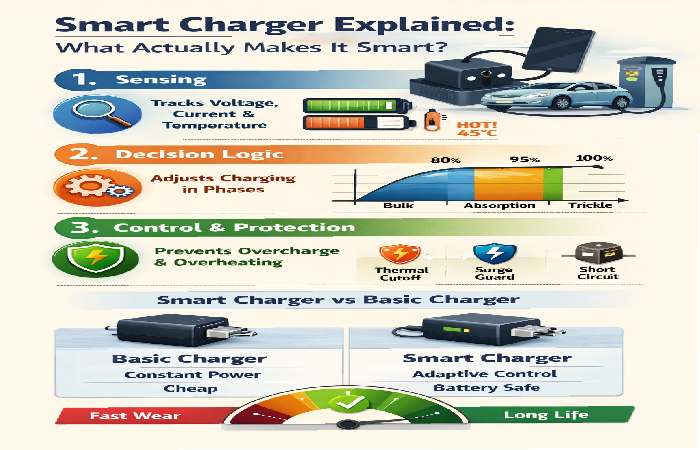
Sensing Layer
A genuine smart charger tracks:
- Battery voltage
- Charging current
- Temperature (charger and device)
Missing temperature sensing is the most common cost-cutting flaw.
Control Logic
Instead of a single charging mode, smart chargers use stages:
- Fast initial charge when safe.
- Slower absorption phase near full.
- Maintenance or trickle phase.
This logic prevents overheating and chemical stress.
Protection Mechanisms
Advanced smart chargers include:
- Thermal throttling
- Over-voltage shutdown
- Short-circuit and surge protection
Auto cut-off alone does not equal safety.
Smart Charger vs Normal Charger vs Fast Charger
| Type | Strength | Weakness | Best For |
|---|---|---|---|
| Normal Charger | Cheap, simple | Battery wear | Emergency use |
| Fast Charger | Speed | Heat damage | Occasional use |
| Smart Charger | Longevity, safety | Higher cost | Daily charging |
A fast charger can be smart—but many are not.
Why Smart Chargers Extend Battery Life
Batteries degrade fastest when:
- Hot
- Fully charged for long periods
- Charged too aggressively
Example scenario:
Two identical phones charged nightly.
One uses a basic fast charger.
The other uses a smart charger with thermal control.
After 18 months:
- Phone A shows reduced capacity and heating.
- Phone B retains stable performance.
The difference is not speed—it’s stress management.
Types of Smart Chargers by Use Case
Smartphones & Tablets
-
Prioritize thermal control and idle power management.
Laptops & USB-C Devices
-
Require negotiation protocols and load balancing.
EVs & Industrial Batteries
-
Focus on cell balancing and safety redundancy.
Who should not buy one
-
Infrequent users charging disposable devices.
Country-Level Price & Feature Comparison (Illustrative)
| Country | Typical Price Range | Common Features |
|---|---|---|
| US | Mid to high | USB-C PD, thermal sensors |
| India | Low to mid | Cut-off focused, fewer sensors |
| UK | Mid | Safety certifications emphasized |
| Germany | Mid to high | Strong thermal regulation |
| Japan | High | Precision charging profiles |
Prices vary widely based on certification and component quality.
Common Myths & Buying Mistakes
-
Myth: Higher wattage means smarter charging.
-
Mistake: Ignoring heat management.
-
Myth: Brand name guarantees safety.
Many chargers fail slowly, not catastrophically.
Practical Buying Checklist (Do / Don’t)
Do
- Check for temperature sensing.
- Prefer adaptive charging profiles.
- Match charger to device power needs.
Don’t
- Buy based on wattage alone.
- Leave devices plugged in on heat-trapping surfaces.
- Assume all fast chargers are smart.
Alternatives to Smart Chargers
- Basic chargers for backup use.
- Power strips with surge protection.
- Built-in battery management systems for large setups.
Final Verdict: When a Smart Charger Is Worth It
If you charge daily and plan to keep devices long-term, a real smart charger pays for itself by protecting battery health and reducing replacement costs.
If speed is your only goal, you may not need one—but expect trade-offs.
FAQs
What makes a charger “smart”?
A smart charger senses battery conditions and adjusts power delivery in real time to reduce heat and stress.
Is a fast charger the same as a smart charger?
No. Fast chargers prioritize speed, while smart chargers prioritize battery health and safety.
Do smart chargers improve battery lifespan?
Yes, when they include thermal control and adaptive charging logic.
Are cheap smart chargers safe?
Some are, but many lack critical sensors and degrade batteries over time.
Is a smart charger worth the extra cost?
For daily charging and long-term use, yes. For occasional use, maybe not.
Do smart chargers stop charging automatically?
Most do, but cut-off alone does not equal full protection.
Does country or voltage matter when buying one?
Yes. Power standards and safety certifications vary by region.