



Table of Contents
Is Zupfadtazak Bad For You? Uncovering the Truth Behind This Viral Term
Have you seen the word “Zupfadtazak” online and wondered, is Zupfadtazak bad for you? You are not alone. Many people in India and around the world are asking this very question. The short and direct answer is: No, Zupfadtazak is not bad for you, because it is not a real thing. It has no medical definition, no scientific backing, and no proven health effects.
This article will break down exactly why you can stop worrying about this term and give you smart tools to spot similar online health hoaxes in the future.
Key Takeaways
-
Zupfadtazak is not real. It is not a drug, herb, or chemical found in nature or the lab.
-
There are no side effects because the substance is a hoax; any list of symptoms is fiction.
-
Do not pay money for products, pills, or “cures” related to this term.
-
Verify health news by checking official sources like the WHO or the Indian Ministry of Health before panicking.
-
Share this article with family members who might be worried about this viral trend.
So, What Exactly Is Zupfadtazak?
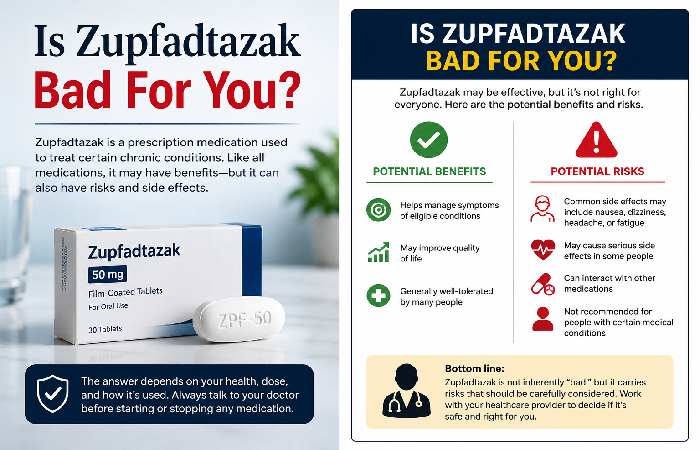
This is the most important question to answer. After reviewing records in major dictionaries, public health databases like the World Health Organization (WHO), and scientific literature, Zupfadtazak cannot be found as a real chemical, drug, food item, or medical condition. It does not exist in any official health capacity.
The term appears to be an invented word with no real meaning in any known language. Health experts call this a “nonsense word” or a modern example of “linguistic phantom”—a term that sounds complex but has no real-world anchor.
Where Did This Word Come From?
Since the term is fabricated, its “origin” is a mystery. It likely started in the vast corners of social media, AI-generated content farms, or as a random word used for testing websites that accidentally went viral.
From mid-2025 onwards, websites started using this term to publish conflicting stories. Some say it is an ancient Brazilian root, others call it a new energy drink formula, while some claim it is a high-tech digital tool. There is no single, consistent story because it is all made up.
-
The Fear of the Unknown: Humans are naturally cautious. When we see a long, unfamiliar word that sounds scientific or medical, our brain flags it as something that might be harmful.
-
The Spread of Misinformation (“Viral Hoaxes”): The question itself creates the problem. Once one person posts “Is Zupfadtazak dangerous?” others assume there must be a reason to ask. This leads to a snowball effect, where the worry spreads faster than the truth.
-
AI and Content Farms: Some websites use AI to write articles about fake terms to get clicks. These articles might list fake side effects like headaches or nausea, purely to rank in search engines.
For the Indian audience, this is especially tricky. With the rapid growth of internet access in both cities and rural areas, many users are exposed to global viral trends without having the background to verify them. This makes online hoaxes like Zupfadtazak particularly effective at causing confusion.
Who Is Spreading This Myth? (And Why They Do It)
It is important to know who is creating these fake “health warnings” about Zupfadtazak. There are two main types:
-
Clickbait Websites: These sites don’t care if the information is true. They just want you to click, read, and look at ads. Using a mysterious “scary” term is a great way to get traffic.
-
AI-generated blogs: Some automated systems create content by mixing random keywords. They might describe Zupfadtazak as a “supplement for energy” in one paragraph and a “toxic industrial chemical” in the next, causing mass confusion.
Debunking the Top Myths: Myth vs. Fact
Let’s clear up the confusion definitively. If you find a website making any of these claims, know that they are spreading myths.
| Myth (The Lie You Read) | Fact (The Scientific Truth) |
|---|---|
| Myth 1: Zupfadtazak is a natural herb from the Amazon/India. | Fact: No botanical or agricultural database contains this name. It is not listed on any legitimate herbal index. |
| Myth 2: It causes dangerous side effects like liver damage or seizures. | Fact: Since the substance does not exist, it cannot cause physical side effects. Any list of side effects is fabricated. |
| Myth 3: You need to buy a detox to remove Zupfadtazak from your body. | Fact: You cannot detox from something that isn’t there. This is a classic scare tactic used to sell fake “cleansing” products. |
| Myth 4: Zupfadtazak is a hidden chemical in packaged foods. | Fact: Food safety regulators (like FSSAI in India or FDA globally) do not list this as an ingredient or contaminant. |
Are There Any Real Risks?
While Zupfadtazak the “substance” is not a risk, there are real dangers associated with believing this myth.
-
Financial Scams: Some users have searched “how much is Zupfadtazak” and found fake price tags ranging from 15toover15toover1,200. Scammers prey on people worried about this term, trying to sell them “Zupfadtazak removal kits” or “protective amulets”. The price is fake because the product is fake.
-
Emotional Distress: Worrying about invisible toxins causes stress and anxiety.
-
Distraction from Real Health: Spending time panicking about a fake internet term takes time away from caring for your actual health.
Who Should Be Cautious (Of The Myth, Not The Compound)
Even though the term is fake, if you fall into any of these categories, you should approach this online topic with extra caution to protect your mental peace:
-
People with health anxiety.
-
Elderly internet users.
-
Caregivers for elderly parents.
Who should avoid reading about this entirely?
If you suffer from severe anxiety, exposure to random “health scare” terms like this can trigger panic attacks. It is best to stick to trusted government health websites and ignore viral trends on WhatsApp or social media.
How to Spot a Health Hoax Like Zupfadtazak
Use this checklist whenever you see a strange health warning online. If the answer to any of these is “Yes,” it is likely a hoax.
-
Check the Source: Is the information coming from a government health site (like the Ministry of Health, ICMR, or WHO) or a random blog you’ve never heard of?
-
Cross-Verify: If it is real, you will find results on PubMed (a database of scientific studies) or government websites. Search for the term there.
-
Read Carefully: Does the article sound vague? Does it use a lot of alarmist language like “They don’t want you to know!” or “Dangerous toxin!”? These are signs of a hoax.
-
Check the Date: Often, these scare stories resurface every few years with the same words.
Actionable Takeaway for Indian Users
-
For Parents: If your child asks you about Zupfadtazak, explain to them that it is a made-up internet game, not a real medicine or poison.
-
For Students: Do not cite any website that talks about Zupfadtazak in your assignments. It is not a valid scientific source.
-
For General Internet Users: If you receive a voice message or forward on WhatsApp claiming “Zupfadtazak is spreading in the water,” do not forward it. Delete it immediately. Report the number to the cyber crime portal if it tries to sell you something.
Conclusion
To return to the main question: Is Zupfadtazak bad for you?
The final, evidence-based conclusion is no. It is not bad for you because it does not exist. It is a phantom word, a linguistic ghost created by the internet. You cannot ingest it, touch it, or catch it. It has no ingredients, no chemical formula, and no side effects.
Your best defense against myths like Zupfadtazak is a healthy dose of skepticism and the habit of checking official medical sources. Guard your health by protecting your mind from online confusion.
Frequently Asked Questions (FAQs)
Q1: Is Zupfadtazak available in India?
Answer: No. Because Zupfadtazak is not a real substance, it is not available in India or anywhere else in the world. Any seller claiming to import or sell it is running a scam.
Q2: Can Zupfadtazak be found in everyday food items like rice or vegetables?
Answer: Absolutely not. Food safety tests conducted by Indian authorities (FSSAI) check for heavy metals, pesticides, and real bacteria. “Zupfadtazak” is not a valid food contaminant.
Q3: I read that it causes seizures. Should I go to the doctor?
Answer: No. You have not been exposed to Zupfadtazak because it doesn’t exist. However, if you feel unwell for any other reason (unrelated to this term), please consult a real doctor.
Q4: Why does Google show results for it if it’s not real?
Answer: Google shows search results based on webpages that exist, not based on the truth of the topic. Many fake websites have written articles about this term, so Google indexes those articles. Always check the source of the information.
Q5: How can I report a website spreading this fake news?
Answer: You can report health-related misinformation on social media platforms (WhatsApp, Facebook, Twitter) using their report functions. In India, you can also file a complaint on the fact check portal of the Press Information Bureau (PIB fact check).
Wikipedia Reference: For guidance on evaluating the reliability of sources and identifying hoaxes, please refer to Wikipedia’s guideline on “Identifying reliable sources (medicine)” and “Wikipedia:Hoax.” These pages provide the editorial standards that require medical claims to be backed by peer-reviewed scientific evidence, which this term completely lacks. https://en.wikipedia.org/wiki/Wikipedia:Reliable_sources_(medicine-related_articles)