

A grow a garden calculator is only useful if you understand its assumptions. When used as a planning framework—not a prediction tool—it helps you design a realistic, productive garden.
Most people search for a grow a garden calculator because they want a simple answer: How much should I plant, and what will I get? The problem is that many calculators give neat numbers that ignore real-world variables. That creates frustration, wasted space, and failed crops. The solution is to use calculators the right way—as decision aids that help you plan conservatively, adapt locally, and improve year over year.
Table of Contents
Key Takeaways
- Garden calculators estimate ranges, not outcomes.
- Yield depends more on crop choice than total space.
- Climate and season length quietly shape results.
- Beginners should always round down calculator outputs.
- The best results come from combining tools with observation.
What Is a Grow a Garden Calculator (And What It Isn’t)
A grow a garden calculator estimates how many plants you can fit in a given space and what you might harvest under average conditions.
It is not:
- A yield guarantee
- A replacement for experience
- A climate-aware decision engine (most aren’t)
The biggest mistake beginners make is trusting the output as fact instead of guidance.
How Grow a Garden Calculators Actually Work
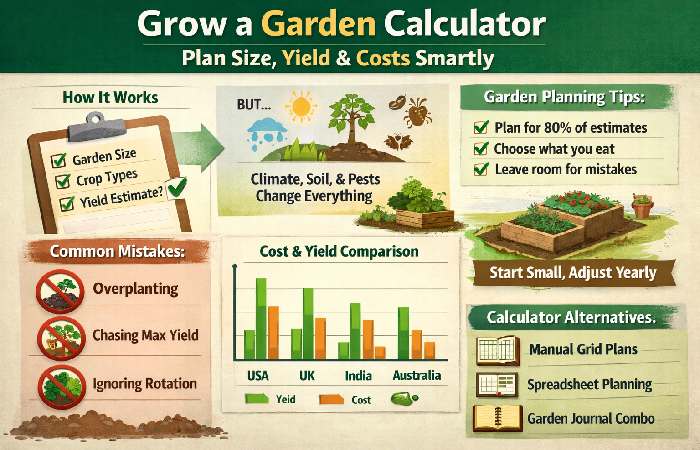
Most calculators rely on three inputs:
- Available space (square feet or meters)
- Crop spacing guidelines
- Ideal growing conditions
What they usually don’t model:
- Pest pressure
- Weather extremes
- Soil nutrient limits
- Plant loss
This is why two gardeners using the same calculator get very different results.
Key Inputs That Matter More Than Garden Size
Crop Type Beats Space
Leafy greens scale well in small areas. Fruiting crops don’t. A 50-sq-ft garden of herbs can outperform a 200-sq-ft garden of poorly chosen vegetables.
Climate Changes Everything
A calculator built for temperate climates underperforms in tropical or arid regions. Growing season length matters more than raw area.
Benchmarks often reference organizations like USDA and FAO, but local extension data is always superior.
Soil and Water Are Silent Constraints
Calculators assume fertile soil and reliable irrigation. If either is weak, outputs should be cut by 25–50%.
Using a Grow a Garden Calculator Step by Step
Checklist
- Measure usable space only
- Select crops you actually eat
- Enter spacing from conservative sources
- Reduce output estimates intentionally
- Leave buffer space for access and airflow
Rule of thumb: Always plan for 80% of the calculator’s recommendation.
Comparison Table – Garden Calculator Outcomes by Country
| Country | Typical Garden Size | Climate Variability | Cost Sensitivity | Calculator Reliability |
|---|---|---|---|---|
| USA | Medium–Large | Moderate | Medium | High |
| UK | Small–Medium | High | Medium | Medium |
| India | Small | Very High | High | Low |
| Australia | Medium | Extreme | Medium | Medium |
| Canada | Medium | Seasonal | High | Medium |
Insight: Global calculators fail hardest where climate variability is highest.
Common Mistakes: Dos and Don’ts
Do
-
Start smaller than planned
-
Track what actually grows
-
Adjust yearly
Don’t
-
Max out spacing
-
Chase “maximum yield”
-
Ignore plant failure rates
Alternatives to Online Garden Calculators
-
Hand-drawn grid planning
-
Spreadsheet-based planners
-
Calculator + garden journal combo (best for beginners)
When a Garden Calculator Is Worth Using
Best for
- First-time planners
- Space-constrained gardens
- Budget-aware growers
Not ideal for
- Experimental planting
- Permaculture systems
- Highly variable microclimates
Author Trust & Methodology
This framework is based on practical gardening logic, crop spacing standards, and yield ranges commonly referenced by agricultural extensions and organizations such as USDA and FAO. Assumptions are conservative by design to reduce beginner failure.
FAQs
1. What does a grow a garden calculator actually calculate?
It estimates plant count and potential yield based on space and spacing. Results are approximate, not guarantees.
2. Are garden calculator yields accurate?
They reflect ideal conditions. Real yields are usually lower due to weather, pests, and soil quality.
3. Is a grow a garden calculator good for beginners?
Yes—if used conservatively and combined with observation. Blindly following numbers often backfires.
4. How much space do I really need to grow vegetables?
Less than you think, if crop choice is smart. More space doesn’t automatically mean more food.
5. Do garden calculators work worldwide?
Not reliably. Climate, season length, and costs vary too much.
6. Should I trust free online garden calculators?
Use them as planning aids, not prediction tools.
7. Can a calculator help reduce gardening costs?
Yes. It prevents overbuying seeds, soil, and supplies.
8. What’s better than a calculator alone?
A calculator plus a simple garden log beats any standalone tool.