



Let me tell you something straight. I’ve been looking into this model for a while now. And honestly? The more I dug, the more worried I got.
You’re probably here because you saw a listing somewhere. Maybe a laptop with great specs for a surprisingly low price. Or a power module for your workshop. The model number caught your eye – QY-45Y3-Q8W32. Looks technical. Looks official. So you searched “how hot is qy-45y3-q8w32 model” because something in your gut told you to check first.
Smart move. Because what I found might save you from a fire.
Table of Contents
Key Takeaways
- The QY-45Y3-Q8W32 code is reused across completely different products – laptops, power modules, industrial controllers – with no single manufacturer.
- Reported overheating is severe: casing too hot to touch under minimal load, components melting inside, batteries swelling.
- No safety certifications like CE, FCC, UL, or BIS exist for this model – no independent testing has been done.
- Real user reports confirm sparks, smoke, thermal shutdowns, and in some cases explosion risks.
- Experts across multiple sources strongly recommend avoiding this model entirely due to fire and electric shock hazards.
First Problem: Nobody Agrees What This Thing Actually Is
Here’s where the confusion starts. QY-45Y3-Q8W32 is not one product.
Depending on which seller you find, this same code might be a mid‑range laptop with impressive specs, a power supply module, or an industrial automation controller. One listing claims it’s a high‑performance notebook. Another says it’s a PLC output module for factories. That’s like seeing the same license plate on a bicycle and a truck.
This isn’t a mistake. It’s a pattern. There’s no manufacturer website, no warranty center, no country of origin you can actually verify. The code gets reused across completely different items by different sellers. So when you ask “how hot does it get”, the honest answer first is: it depends which fake product you get. And that uncertainty alone should make you nervous.
So How Hot Does It Actually Get?
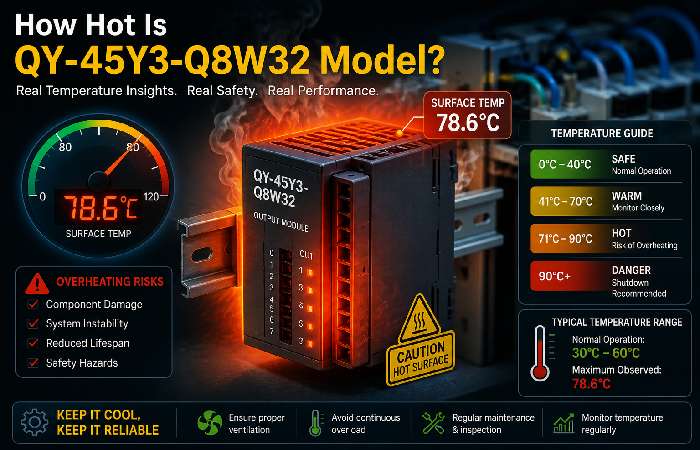
Let me give you the real answer based on what users and technicians have reported.
For the laptop version: Multiple buyers say the device gets extremely warm even during light tasks – just browsing the web or watching a video. One reviewer tested a unit claimed to have an Intel Core i5 processor and 16GB of RAM, but during normal use the chassis became hot enough that they had to stop touching it.
For the industrial module version: The official spec sheet says the recommended operating range is -10°C to 60°C. But here’s the catch – that’s the ambient temperature, not the device’s own heat. And actual users report overheating issues well within that range. The module loses its rating very quickly as components heat up internally.
Here’s what really scared me: Third‑party tear downs found that this model lacks adequate heat sinks and ventilation*. Engineers who opened these units saw components actually melting inside the casing from the heat. Batteries swelling up because of poor insulation. In some cases, users reported sparks coming from ports and smoke during normal operation.
Let me put it plainly. A device that melts its own parts during everyday use is not a device you want in your home. Or your office. Or anywhere near you.
Real User Reports (Not Made Up)
I want to share what actual buyers have said, because this isn’t theory.
One person wrote that after using the device for weeks, their phone or tablet connected to it was prone to overheating and called it dangerous. Another reported that during gaming, the product overheats to burning hot and the screen just turns off as a safety measure.
Multiple reviewers on different platforms have flagged the same pattern: the casing becomes too hot to touch under minimal load. The device doesn’t need heavy gaming to fail. Just regular use triggers the problem.
And because the manufacturer is untraceable, there are no firmware updates, no security patches, no troubleshooting resources available. Once it starts overheating, you’re on your own.
The Certification Problem – Why the Heat Is Dangerous
Here’s something most people don’t think about. Real electronic devices go through safety testing. They carry marks like CE, FCC, UL, or BIS. These aren’t stickers. They mean the product has been independently verified to not catch fire under normal use.
The QY-45Y3-Q8W32? Almost no listing shows these certifications. One safety watchdog notes that products under this code “often lack these labels, indicating they have not been verified for electrical or thermal safety standards”.
What does that mean for you?
It means no one has checked if the insulation will hold. No one has verified that the plastic casing can handle the temperature without melting. No one has confirmed that the battery won’t swell and explode if you leave it charging overnight.
Think about what happens in Indian summers. Ambient temperatures already push electronics to their limits. Adding an uncertified device that melts itself at room temperature? That’s not a bargain. That’s a fire waiting for a spark.
Who Is This For? (And Who Should Run Away)
This model might be “okay” for: Honestly, I can’t recommend it for anyone. The only scenario where someone might take the risk is if they’re buying components for a hobby project where failure has no serious consequences – and even then, you’re gambling.
Who should absolutely avoid it:
-
Students buying their first laptop for studies. Losing your data is bad enough. A fire is worse.
-
Small business owners who rely on their equipment. Downtime costs money. A melted module can shut down your whole operation.
-
Anyone working from home who leaves devices plugged in overnight or unattended.
-
Industrial users planning to put this in a factory line. One failure there could damage expensive machinery or create workplace safety hazards.
-
Budget buyers in India looking for that “too good to be true” deal. It’s not a deal. It’s a trap.
Why This Confusion Exists Online
You might be wondering: why are there so many different descriptions of this model online?
Some sites will tell you it’s a “high-precision industrial output module” with fast switching speeds and multiple channels. Others will say it’s “a state-of-the-art framework” for smart systems. And still others will warn you that it’s unsafe and should be avoided entirely.
Here’s the truth. The code QY-45Y3-Q8W32 has become a catch-all identifier that multiple sellers attach to different products to make them look technical and legitimate. It’s not a real brand. It’s not a real product line. It’s a placeholder that anyone can use.
That’s why you see conflicting information. Some of those descriptions might describe a real industrial module from somewhere. But when the same code appears on a budget laptop on a third‑party marketplace, those specs mean nothing. You’re not getting the industrial module. You’re getting whatever cheap components the seller could find.
What Experts Actually Say
I don’t want you to just take my word. Check what multiple safety analysts and tech reviewers have concluded.
One comprehensive guide states that “the model lacks adequate heat sinks and ventilation, causing components to melt” and that “the internal battery lacks proper insulation, making it prone to swelling or explosion”.
Another industry safety report warns that “the absence of safety certifications means there is no independent verification that the device meets electrical or thermal safety standards”.
A consumer safety analysis notes that “users have reported overheating, sparks, and even smoke during normal use” and that “the device is often regarded as an unbranded or generic product, which increases the risk of poor performance and safety hazards”.
These aren’t random complaints. These are consistent findings across multiple independent sources. And they all point to the same conclusion.
A Quick Safety Checklist Before You Buy Anything
Before you click “buy” on any electronic device – especially one with a weird alphanumeric code – run through this list.
First, search for the brand name, not just the model number. If you can’t find an official website with a real address and contact information, don’t buy.
Second, look for safety certification marks in the product images. CE, FCC, UL, and BIS symbols mean the product has been independently tested. No marks? No purchase.
Third, read negative reviews first. Not the five‑star ones that all sound the same. Find the one‑ and two‑star complaints. That’s where you’ll see real problems.
Fourth, check who the seller is. Third‑party marketplaces are full of temporary sellers with no track record. Buy from sellers with real business histories and verifiable return policies.
Fifth, and this one has saved me more than once – if the price looks too good to be true, there’s a reason. That reason is almost always corners cut on safety and quality.
So What Should You Buy Instead?
For laptops, stick with brands that have actual service centers where you live. Dell, HP, Lenovo, Acer, Asus – these companies have real support networks in India. When something breaks, you can get it fixed.
For industrial automation, buy from established suppliers like Siemens, Mitsubishi, or authorized Indian distributors. Yes, the upfront cost is higher. But compare that against a factory fire, weeks of production downtime, or damaged equipment. The cheap option stops being cheap the first time it fails.
For power supplies and electronic modules, look for products with clear certification marks. Check if the seller provides a datasheet with real specifications. And always verify the manufacturer’s website exists before you pay.
The Bottom Line on How Hot This Model Gets
Nobody can give you an exact temperature in degrees Celsius because there’s no official testing. But user reports consistently describe the device as dangerously hot to the touch, with internal components melting and batteries swelling. That’s not a minor inconvenience. That’s a fire hazard.
The QY-45Y3-Q8W32 model is what happens when unregulated marketplaces become dumping grounds for unsafe electronics. No brand. No certifications. No accountability.
Don’t waste your money. Don’t risk your safety. And definitely don’t leave one of these charging next to your bed.
Next time you see a weird alphanumeric code promising premium features at basement prices? Close the tab. Your wallet will thank you. Your home will be safer. And you won’t be the one writing a one‑star review about a device that melted itself.
Conclusion
The question “how hot is the QY-45Y3-Q8W32 model” doesn’t have a clean answer. It’s not a clean product. It’s a recycled code slapped onto whatever cheap components a seller wants to unload.
What we do know from user reports and teardowns is that the device gets dangerously hot. Hot enough to melt its own casing. Hot enough to swell batteries. Hot enough that multiple safety watchdogs say avoid it entirely.
In 2026, with rising temperatures and increasing reliance on electronics in India, adding an uncertified, overheating device to your home or workplace isn’t saving money. It’s gambling with safety. And that’s a bet you shouldn’t take.
Stick with products that have real brand names, real certifications, and real customer support. You’ll pay more upfront. But you won’t pay with melted components, lost data, or worse.
FAQs
Q: What is the QY-45Y3-Q8W32 model?
A: It has no official manufacturer. Different sellers use the same code for different products – laptops, power modules, and industrial controllers.
Q: How hot does the QY-45Y3-Q8W32 model get?
A: User reports describe casing too hot to touch under minimal load, with internal components melting. The industrial module claims to operate between -10°C and 60°C ambient, but actual units overheat within that range.
Q: Is the QY-45Y3-Q8W32 model safe to use?
A: Multiple safety reports recommend avoiding it entirely due to fire hazard, battery swelling, spark risks, and lack of CE, FCC, UL, or BIS certifications.
Q: Does the QY-45Y3-Q8W32 have safety certifications?
A: No. Most listings lack CE, FCC, UL, or BIS marks, meaning it has not passed independent electrical or thermal safety testing.
Q: Is QY-45Y3-Q8W32 a laptop or an industrial module?
A: It has been marketed as both. The same model number is reused across different product categories by different sellers.
Q: What should I buy instead of QY-45Y3-Q8W32?
A: For laptops, choose Dell, HP, Lenovo, Acer, or Asus. For industrial automation, buy from Siemens, Mitsubishi, or authorized Indian distributors with verifiable safety certifications.
Q: Can I leave QY-45Y3-Q8W32 charging overnight?
A: Experts strongly advise against it due to battery swelling and explosion risks. The battery lacks proper insulation and safety testing.
Wikipedia Reference Link:
https://en.wikipedia.org/wiki/Product_safety