

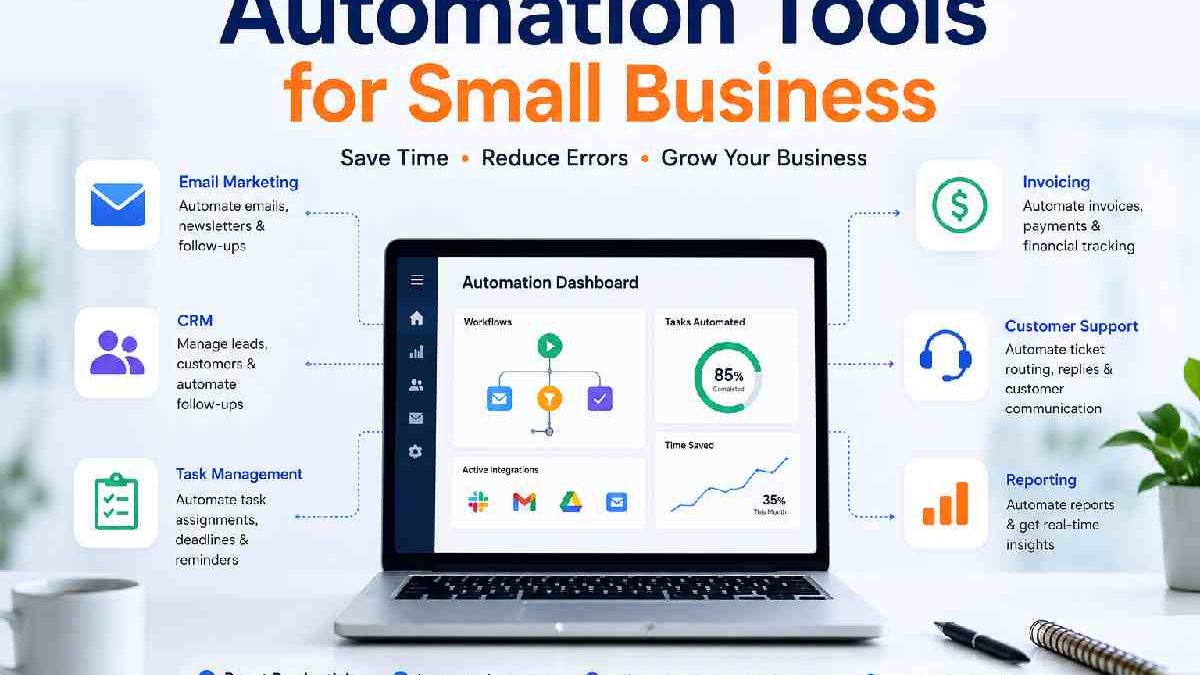
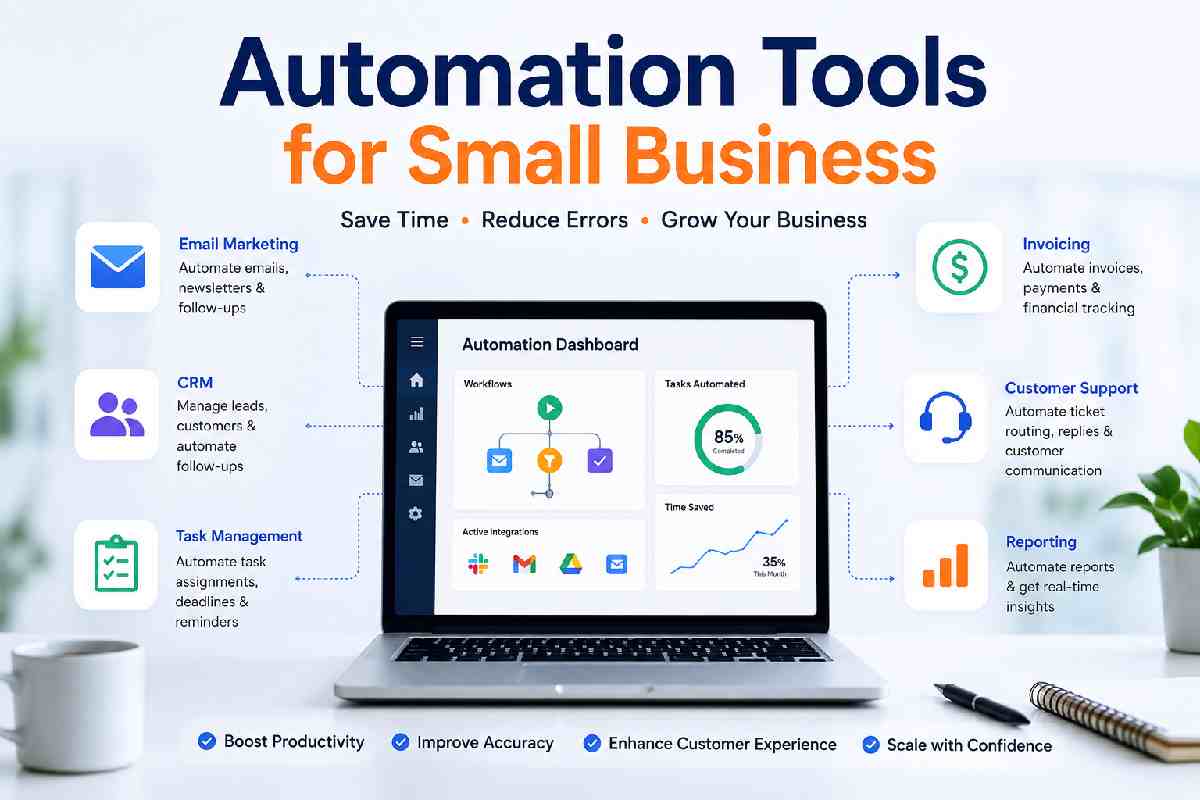
Being a small business owner, you probably deal with a bunch of responsibilities, with never enough time and resources to carry them all out. Responding to customer inquiries, handling bills, scheduling social media messages, monitoring progress and projects: repetition of those tasks consumes hours that could be invested in growing your customer base and strategy.
Business automation tools might come for rescue. Instead of replacing human workers, those solutions reduce the workload, giving space for your team to concentrate on tasks that actually matter to your company, like establishing stronger client ties or outlining and implementing strategic goals for expansion.
This manual includes everything you need to know about small business automation, covering how to get it done and what tools and options are out there, along with their pros and cons.
Table of Contents
What Are Business Automation Tools?
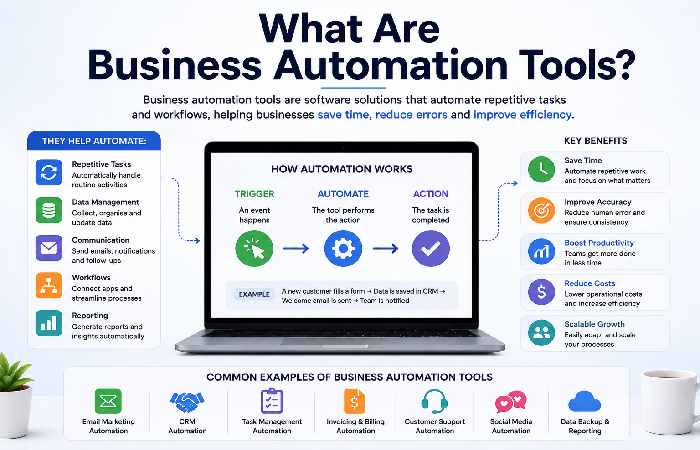
Business automation software are tools to help you do routine work with little to no human interference.
What a business does is automate recurring tasks by having a predefined process that will execute when a certain condition is met. This allows the businesses to not do the same task by hand every single day.
Here are few things that businesses can automate:
* Email auto-responder or welcome messages
* Invoice generation
* Updating CRM contacts
* Social media scheduler
* Backing up data
* Allocating support tickets
* Project management
The goal here isn’t replacing human workforce; it’s about taking over monotonous work.
Why Automation Matters for Small Businesses
By and large small businesses do not have large teams at their disposal unlike large organizations. Let Automation Work For Small Business Like Others Automation in processes helps. Save valuable man-hours Eliminates chances of human error speeds up customer’s response time Businesses processes do not vary standardize in each step Help grow your business without the additional staffing cost Even automating one or two of the mundane processes to help alleviate the pressure
Types of Automation Tools for Small Business
Email Marketing Automation
Email platforms automatically send newsletters, welcome sequences, abandoned cart reminders, and customer follow-ups.
Common uses include:
- Lead nurturing
- Product announcements
- Event reminders
- Customer onboarding
Customer Relationship Management (CRM)
CRM automation keeps customer records organised by automatically:
- Recording interactions
- Assigning leads
- Scheduling follow-ups
- Sending reminders
This helps businesses maintain stronger customer relationships.
Project Management Automation
Project management software automatically:
- Creates recurring tasks
- Sends deadline reminders
- Updates project statuses
- Assigns responsibilities
This improves collaboration across teams.
Accounting and Invoicing Automation
Financial automation tools simplify bookkeeping by:
- Generating invoices
- Recording payments
- Tracking expenses
- Creating financial reports
They also reduce data entry errors.
Customer Support Automation
Support platforms often include:
- AI chatbots
- Ticket routing
- Knowledge bases
- Automated replies
These features improve response times while allowing human agents to handle more complex enquiries.
Social Media Automation
Marketing teams can:
- Schedule posts
- Publish across multiple platforms
- Monitor engagement
- Generate performance reports
This maintains a consistent online presence.
Key Features to Look For
When comparing automation software, consider the following features:
- Easy workflow builder
- Third-party integrations
- Mobile access
- Reporting dashboards
- Security controls
- User permissions
- Cloud storage
- Custom automation rules
- Scalability
- Customer support
Not every business requires advanced automation. Selecting software with features that match current needs often provides better value.
Comparison Table: Popular Automation Tool Categories
| Automation Category | Common Tasks | Best For | Learning Curve |
|---|---|---|---|
| Email Marketing | Campaigns, newsletters | Marketing | Low |
| CRM | Lead management | Sales teams | Medium |
| Project Management | Task automation | Teams | Low |
| Accounting | Invoices, bookkeeping | Finance | Medium |
| Customer Support | Ticket handling | Service teams | Medium |
| Workflow Automation | Connecting apps | Growing businesses | Medium-High |
Workflow Example: How Automation Works
Below is a simple customer enquiry workflow.
Customer submits contact form
↓
Lead automatically enters CRM
↓
Welcome email is sent
↓
Sales notification created
↓
Follow-up reminder scheduled
↓
Customer record updated after interaction
This simple automation eliminates several manual steps while keeping customer communication organised.
Popular Automation Platforms Worth Considering
Several well-known platforms serve different business requirements.
| Platform | Primary Purpose | Suitable For |
|---|---|---|
| Zapier | App integrations | Small businesses |
| Make | Visual workflows | Growing businesses |
| Microsoft Power Automate | Microsoft ecosystem | Office users |
| HubSpot | CRM & marketing | Sales teams |
| Trello Automation | Task management | Small teams |
| Asana Automation | Project workflows | Project managers |
| Mailchimp | Email marketing | Online businesses |
| QuickBooks | Accounting | Finance management |
Each platform focuses on different business needs rather than offering identical functionality.
Benefits of Automation Tools
Businesses often experience improvements in:
Time Savings
Routine tasks complete automatically.
Better Accuracy
• Reduce errors due to less typing and duplicate entry.
Enhanced customer experience
• quicker customer service lead to better consumer satisfaction.
• All work processes follow set rules.
Ability to cope with increased work volumes without large increase in personnel needs.
Expectations: What Automation Cannot Do
Automation is extremely helpful, but it has realistic limitations.
Businesses should not expect automation to:
- Replace strategic thinking
- Handle every customer interaction
- Solve poor business processes
- Eliminate the need for staff training
- Make complex decisions independently
Successful automation still requires planning, monitoring, and occasional adjustments.
Pros and Cons
| Pros | Cons |
|---|---|
| Saves time | Initial setup requires effort |
| Reduces repetitive work | Some tools require subscriptions |
| Improves consistency | Learning curve for advanced workflows |
| Supports growth | Poorly designed workflows can create errors |
| Integrates business systems | Some integrations require premium plans |
Who Should Use Automation Tools?
Automation works particularly well for:
- Small business owners
- Freelancers
- Online retailers
- Marketing agencies
- Consultants
- Healthcare practices
- Educational businesses
- SaaS companies
- Local service providers
Who May Not Need Extensive Automation?
Businesses with very simple operations may not benefit from complex automation.
Examples include:
- Sole traders with few clients
- Hobby businesses
- Temporary projects
- Businesses without digital workflows
Starting with one or two automations is often more practical than automating everything immediately.
Are Business Automation Tools Legitimate?
Yes.
Many automation platforms are widely used across industries and follow recognised security standards.
However, businesses should always:
- Choose reputable providers
- Enable multi-factor authentication
- Regularly review permissions
- Monitor connected applications
- Back up important data
Automation is only as reliable as the workflows created by users.
Alternatives to Full Automation
Automation is not the only option.
Businesses may also consider:
- Virtual assistants
- Outsourcing administrative work
- Standard operating procedures (SOPs)
- Manual task templates
- Shared team checklists
Often, combining automation with human oversight delivers the best results.
Buying Tips Before Choosing Automation Software
Before purchasing any automation platform, consider:
Identify repetitive tasks
List activities repeated every day or week.
Check integrations
Ensure the software connects with your existing tools.
Consider future growth
Choose software that can scale alongside your business.
Compare pricing carefully
Monthly subscriptions vary considerably.
Test free versions
Many providers offer free plans or trial periods.
Common Mistakes to Avoid
Businesses often make these mistakes:
- Automating inefficient processes
- Creating overly complex workflows
- Ignoring security settings
- Failing to monitor automation performance
- Automating customer communication excessively
Automation should improve customer experience—not make interactions feel impersonal.
Frequently Asked Questions
What are automation tools for small business?
Automation tools for small business are software that automate tasks that are monotonous and repetitive such as invoicing, marketing, customer support, or project management in order to streamline business processes.
Automation tools are expensive?
There are various affordable plans or free services available for small businesses. The cost would gradually rise based on the employees and features or the volume of automated tasks you intend to perform.
What is the best automation tool for beginners?
Each small business needs are different. Email marketing, project management, or workflow automation software could be ideal solutions since these have intuitive interfaces.
Will automation replace staff?
Not at all. Automation would serve as a helper for your staff by completing the repetitive tasks so that they could concentrate on tasks like making decision, problem-solving, and cultivating customer relationship.
Is automation worth for tiny-small business?
Yes. Even automating simple tasks like sending appointment reminder or generating invoice could be a great time-saver for a very-small business.
Conclusion
However, while there is a plethora of great software out there with all the bells and whistles a small business might need to embrace automation, don’t choose a tool based on functionality alone. Identify which automation software would address actual issues in your business first, not based on functionality that would require operational changes.